
Border Ecologies is a two-part inquiry into borders, exploring their ecological reality along with their economic and political origin and uses.
How do you make injera? How do you make a nation?
In every telling I’ve heard since leaving Ethiopia, injera refuses to be made outside of its homeland. Every story of a successfully baked injera in the United States, even in neighboring Sudan, is either a rumor, a failure, or a belabored experiment that loses integrity and appeal.
Injera’s native land stretches outward from the Eritrean and Ethiopian highlands into their surrounding valleys where teff, a seed-bearing grass indigenous to the region, grows. The seed is notably small, slipping like sand between your fingers. The grass, too, is delicate. “The sheer weight of the seeds bend the stems to the ground where they fall pell mell,” writes Daniel Jote Mesfin in Exotic Ethiopian Cooking, a cookbook originally printed in 1987. Despite its ultra-fine quality and labor-intensive harvest, teff has invited cultivation across the horn of Africa for at least two thousand years. Sometime during that period, teff seeds were reaped, milled, mixed with water, fermented and steam-baked to produce injera. It’s a remarkable amount of work for daily bread.
Teff injera, as I know it, is diaphanous and pliant, taking on the elegant qualities of the grass that bears its seeds. When fresh, injera shouldn’t break but tear. Its tart taste shouldn’t lean towards astringent. Laid flat, circular and dotted with eyes from edge to center, it should withstand hosting or gripping stews, meat, legumes and vegetables. There are instances where a lack of time or other resources require that injera is eaten simply with a milled red pepper spice blend, hastily mixed with water, honey wine or simply as-is, in powder form. Simple, and requiring little effort, this meal might be the one expatriates miss most after leaving home.
Homesickness itself is a hunger. I’m convinced that’s why we turn to food to relieve it. But to the homesick, injera does not oblige so easily. Over the course of the last 60 years, as East African diaspora left home, often in waves following conflict and economic conditions that make a war of daily life, the ramifications of injera’s refusal to bake “correctly” in new geographies has set off formidable economic and spiritual quests. On the side of trade, fresh injera is shipped daily and by the tens of thousands from Addis Abeba’s Bole International Airport to various cities around the world. For those lucky enough to live near a city that receives direct flights from Bole, networks of grocery stores and tradesmen have formed to deliver our beloved food. The existential quest for injera is less easy to resolve. How can your daily bread abandon you when you miss home the most? Could injera be so cruel?
Injera, like other fermented products, has microbial agency — a refusal to the artifice of globalization and its seemingly innocuous but terrifyingly homogeneous ambitions of accessing everything, all the time, anywhere.
The first time I ate foreign injera was on my first day in the United States. I didn’t make much of its unfamiliar thickness and its limp weight. Jet lagged and repeating the motions of eating, it took more time to notice its inaccuracy and slowly, feel entirely betrayed. Soon, I noticed that in America, even the mold grew differently on injera. The white specks whose taste I knew even as I ate around them were nowhere to be found in this country. Instead I was met with the kind of green mold you’d find on any loaf of bread left untended. The theories as to why injera could not be replicated beyond seemingly arbitrary national borders were plenty and a source of great debate. Everyone presented their argument: Some blamed the American water for not rendering the almost gauzy ideal we seek in injera. (I’ve heard gossip of a woman who flew to America with Ethiopian tap water in her checked luggage.) I remember asking Nigisti, who runs my favorite restaurant in Oakland, about her injera which didn’t betray me as much as the others. She recounted that when she left Eritrea and arrived in Sudan, she had to use sorghum in her teff batter to get a consistency she liked. In California, she adds wheat. What does injera batter know about a national border?
Some have argued the grain is intelligent enough to know when it’s not grown on home soil. Most teff used by Eritrean and Ethiopian diaspora isn’t grown in its indigenous highlands but in places like Idaho and Spain. But this theory was dispelled thoroughly with Ethiopian grown teff unable to render injera like it did back home if baked outside of its highlands. My uncle’s friend Menkir Tamrat tested this theory in reverse, bringing teff grown in Nevada to Ethiopia three times. “[I] gave it to three different bakers to test some of the fairytales,” he tells me. “The result was that you couldn’t tell it apart from the local injera.”
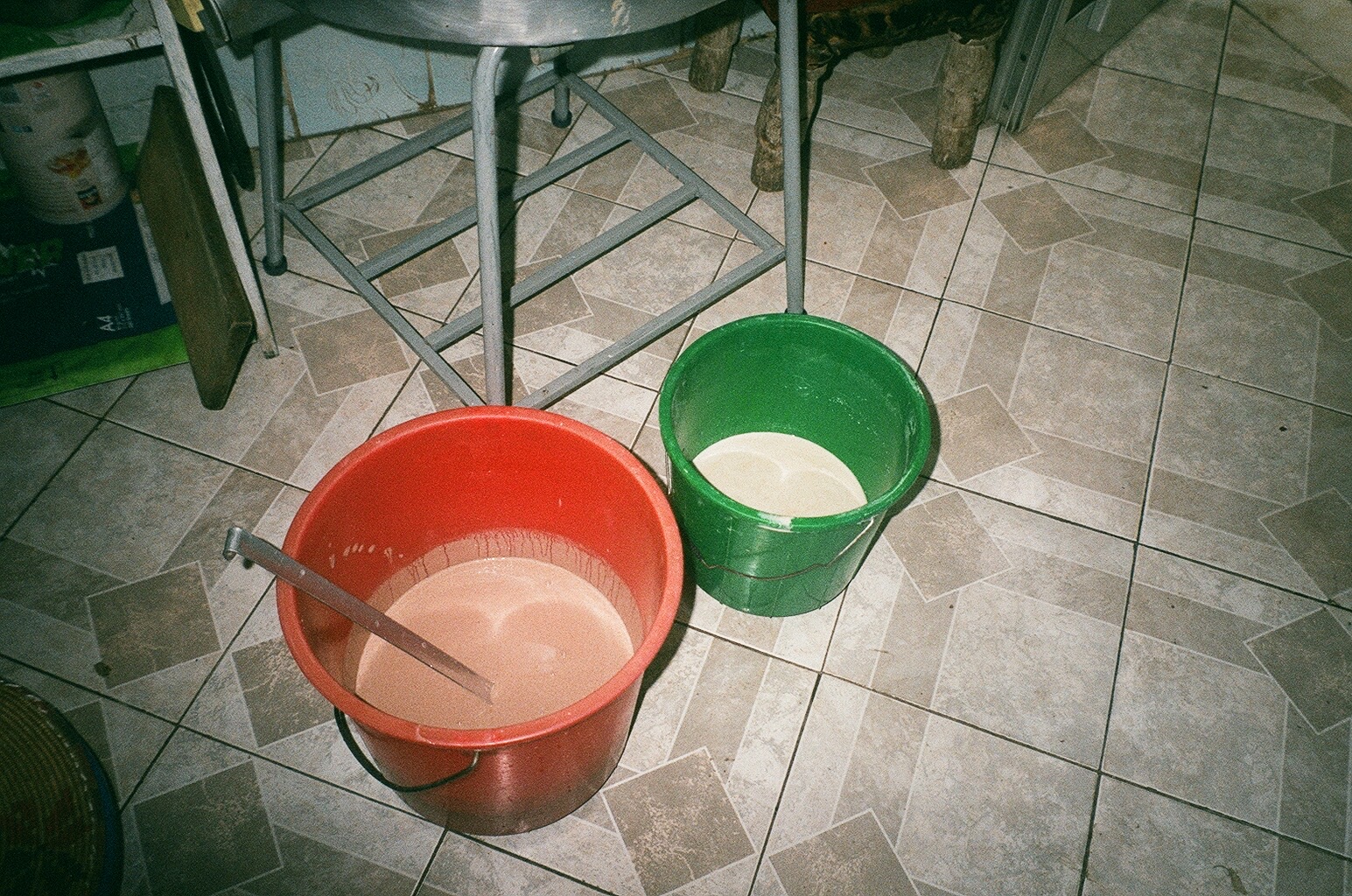
This has left fermentation as the likely culprit which, in environments outside of the East African highlands, was reported to be sluggish and unpredictable in its yield by its bakers. Injera batter’s fermentation is airborne after all, hosting dozens of species of yeast and bacteria to transform its state and determine its particular texture and taste. Injera, like other fermented products, has microbial agency — a refusal to the artifice of globalization and its seemingly innocuous but terrifyingly homogeneous ambitions of accessing everything, all the time, anywhere.


Menkir took his suspicions about fermentation a bit further. In 2015, he commissioned a comparative test at the University of California at Davis to study the yeast and bacterial composition of batter he brought from Addis and a batch he made in California. The results weren’t conclusive — yeast and bacteria populations are mercurial and therefore slippery to measure. They interact with time and space very differently. Even an hour can change the microbial demographics of the batter.
Since that study and his dozens of experiments after, I write to Menkir to ask where he stands these days and he replies by email from Addis: “I just threw up my hands in the air and moved on to other things, still fermentation-related matters: Sourdough baking and tella brewing, curiously enough—but only for personal consumption.” I don’t blame him.
These days, I come to injera’s defense. How can we demand a sameness from injera that we ourselves find impossible to maintain? Whether we’ve moved away from home by will or by force, we’ve irrevocably changed, finding no sensible options besides that of adapting to our new environments.
How can your daily bread abandon you when you miss home the most? Could injera be so cruel?
At the start of a civil war in Ethiopia in 2020 that’d bubble over into Sudan and Eritrea, forcing a new wave of displacements, I wrote to myself, “Ethiopia is not a country of people to the West. Like other African nations, it functions as an area of economic strategy via extraction and dumping (‘trade’), and military expansion (‘security’).” Nationalism and any assurance borders could offer have long felt crass to me, especially during war, ostensibly a time to re-affirm national pride and identity. I’ve encountered most national borders like many do, at airports — proxy sites of “national” enforcement with a porosity dictated by global economic order. National lines on a map are often litigated through racist hierarchies and their wars. Their artifice requires tremendous and sustained violence. “While corporate elites and politicians outdo one another to see who can build the tallest wall as an edifice to xenophobic nationalism and state sovereignty, borders are actually elastic,” writes Harsha Walia in her 2021 book Border and Rule: Global Migration, Capitalism and the Rise of Racist Nationalism. “Most maps do not conceptualize the shifting cartography of borders,” Walia elaborates on the frameworks that mediate borders. “Bordering regimes are increasingly layered with drone surveillance, interception of migrant boats, security controls, and boots on the ground far beyond territorial limits.”
I think of injera’s intelligence and its count of its own borders, measured in delicate nuances. I think of a batter alive beyond our measure and our surveilling eyes, an aerobic fermentation and its dynamic demography, always shifting, never still. I think of the batter in the bucket and everything it knows.